In this morning’s opening round the players had no time to draw breath, as the first two deals had slam potential:
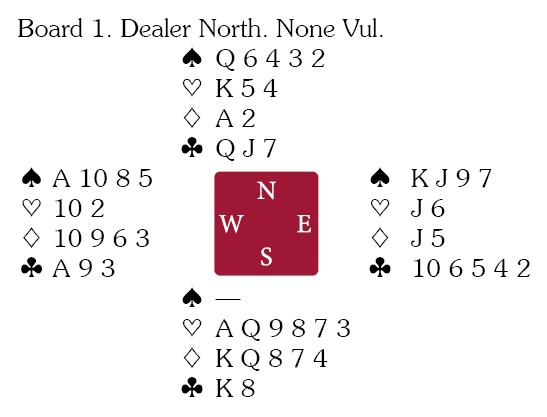
6[H] is eminently playable but after the auction starts 1[S]-2[H] what should North rebid?
I found players rebidding 2[S], raising to 3[H] and jumping to 4[H]. I could use up a lot of space discussing the merits of all those, but rebidding spades with such a poor suit would not be my first choice. Were the auction to go 1[S]-2[H]-2[S]-3[D] should North bid 3[H] or 4[H]? If North opts for 3[H] should South settle for game or make one last try with 4[C]? If North jumps to 4[H] should South keep going, assuming that North is likely to have useful cards in both red suits?
If North raises to 3[H]/4[H] how should South proceed? (Here too you can decide, assuming 2[H] is game forcing, which bid you would prefer to make with North’s cards.)
33 pairs got to 6[H], 9 of them in the Venice Cup and 8 in each of the other events.
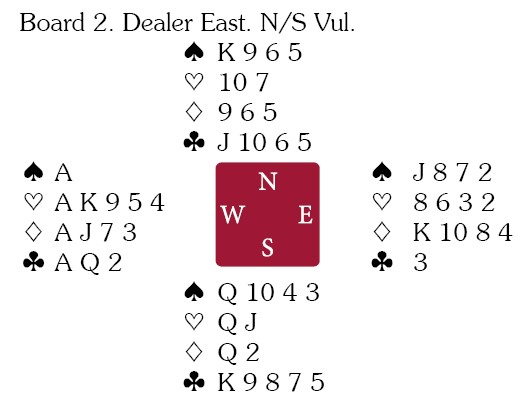
As a general rule, deals where one hand holds all the aces can be awkward. You would also like to be in 6[H] on these cards, but only 28 pairs across the four events managed it.
Helgemo and Grude had an excellent auction:
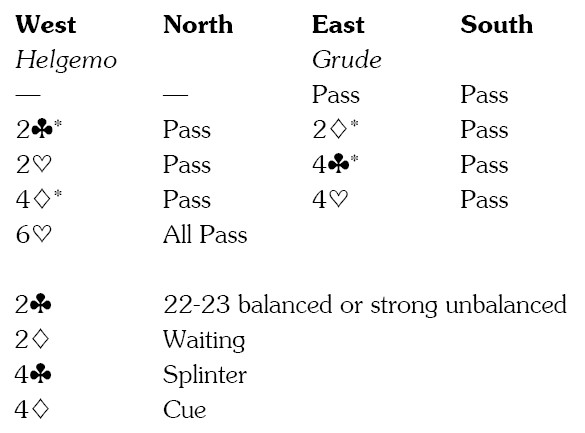
Having responded 2[D] East was happy to splinter, after which it was easy for West to go on to 6[H].
It looks easy, but in the other room EW bid 1[H]-3[H]-3[S]*-4[C]-4[D]*-4[H]-Pass. I’ll leave you to ponder East’s final pass – poor trumps but a potentially useful [D]K. Perhaps one more effort with 5[H] would be in order?