Some deals are more difficult than others. This was Board 11 from the third round of the McConnell:
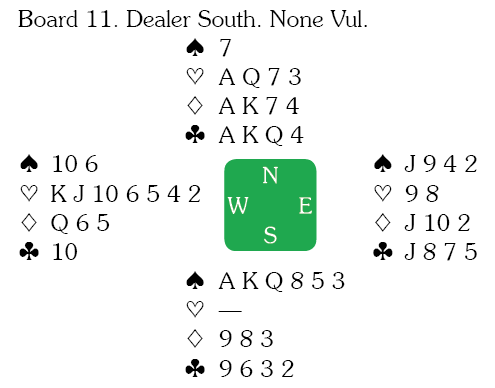
The first question is what should South open?
Suppose you start with 2[S] (perhaps questionable when you have this holding and a void on the side). What should North do?
If your answer to that question is to bid 3[C] then should South raise to 4[C], rebid 3[S] or bid 4[H] (which must be a cue bid agreeing clubs).
Some players might prefer to open 3[S]. Would you then try 4[C] with North’s cards?
Because a weak two based on a suit headed by the AKQ is a rarity, my vote would go to 1[S]. Were West to pass North responds 2[C] and South raises to 3[C] (null point if you prefer to rebid 2[S]). Here West would surely overcall 3[H] after a 1[S] opening and that leaves North with something to think about. Assuming North doubles would you introduce your emaciated clubs?
On a good day you might take all the tricks with clubs as trumps, but here the 4-1 trump break makes that impossible. However, 6[C] is excellent, the basic idea being to cash two clubs, play four rounds of spades, ruffing and then cross ruff, eventually scoring the slam going trick en passant with the [C]9.
Suppose you land in 6[S] and West leads the [C]10?
You win in dummy and cash three spades West discarding a heart. Now the winning line is to go to dummy with a club, cash the [H]A pitching a diamond, ruff the [H]Q, cash dummy’s top diamonds, ruff a diamond, go to dummy with a club and play the {7 scoring the [S]8 en passant. At the one table that reached 6[S] declarer did not find this line, and no-one found a route to 6[C].